lunes, 27 de julio de 2009
Despicable

This is utterly despicable. Apparently the grand, bipartisan bargain being worked out in the Senate Finance Committee includes neither a public option nor an employer mandate. However, the pieces favored by the drug, medical supply, and insurance industries--most importantly, subsidies to buy private insurance and the individual mandate--are included. And to top it all off, the bill includes a tax on benefits for generous health care plans, which is basically a smack in the face to organized labor. In essence, any ounce of progressivism has basically been squeezed from the bill, while the major industry players get everything they want. I wonder if it has anything to do with lobbying and campaign contributions from the health care industry?
I realize that there are a lot of different versions of health care reform floating around. The Senate Finance Committee is just one of many committees in the House and Senate which are working on reform plans. Nevertheless, the craven capitulation to business interests exhibited by the Finance Committee is so grotesque that I had to comment on it.
There could be a silver lining, however. Perhaps sickening examples of corruption such as this one will further convince the public that the piecemeal reform efforts currently being advanced in Washington are hopeless and that the only solution is single payer, universal medicare.

martes, 14 de julio de 2009
Bernie Sanders on Public Health Care
Via Ezra Klein, please check out this fantastic clip of Bernie Sanders providing the United States Senate a little lesson on the U.S. health care system. I agree completely with Mr. Klein on this one, this clip shows the power of having legitimate progressive voices in Washington. I would go even further, though. Frankly, this little 3 minute speech is downright radical. On the floor of the U.S. Senate, Sanders exposes the profound gap between the views of the American people on health care and those of the folks whom we have elected to represent our interests. He also reveals that, gasp, America already has a single payer and fully socialized health care system, both of which are amazingly popular! Thank you, Mr. Sanders and thank you to the people of Vermont for electing him.
lunes, 6 de julio de 2009
"There’s very little truth to anything you’ve read about the coup in American newspapers"

Via Borev.net. Ken Silverstein of Harper's has a great piece on the coup in Honduras, as well as Obama's abysmal response. The title of this post is a quote from Silverstein's article. It's short, sweet, and to the point. Check it out.
viernes, 3 de julio de 2009
Terrific Piece on Healthcare
Jane Slaughter over at Labor Notes just wrote a great piece about Labor's role in the health care reform debate. I highly suggest you read it. In the article, Ms. Slaughter points out that, while the union rank-and-file largely supports universal medicare (hundreds of union locals, as well as several state federations and labor councils have endorsed it), the leadership of Change to Win and the AFL-CIO do not, and have instead come out in favor of public-private competition. At the closing of the article, Ms. Slaughter expressed, in the clearest and most concise language I have ever read, why this position is so truly puzzling (and maddening):
Everyone who is following the health care debate knows that passing single payer in the current Congress is basically impossible. According to Ms. Slaughter, the sponsor of single payer legislation in the house, John Conyers, was asked “What would it take this Congress to pass single payer?” back in May. His response: "Nuclear weaponry”. Unfortunately, I don't think Mr. Conyers is too far off. The health care industry just has too much power. Our legislators are too dependent on health care campaign contributions and simply too corrupt to challenge the interests of the industry. It truly is a sad reflection on the health of our democracy when arguably the most popular health care reform proposal, supported by two thirds of the public and 60% of Physicians, is "off the table" and politically impossible. That's the reality we're living in. Nevertheless, if a strong public option which competes with private insurers is the best we could possibly get, as unfortunately I think is the case, then why come out for a public option right out of the box? Even if the labor movement does not universally agree that single payer is the best option (Andy Stern, for one, I'm sure is against it), it would nonetheless be a strong negotiating tactic for them all to come out in favor of single payer. Sure, labor is not what it once was. But unions still represent tens of millions of Americans. The unions also ought to have at least a little leverage over Obama, after they were central to his election victories in places like Pennsylvania and Ohio last year.
Imagine if the entire labor movement joined the movement for single payer, which is already growing and making waves without the support of the national union leadership. Imagine if the rally held last week, which drew 7,000 people, called for Medicare for all. In such circumstances, wouldn't the Congress have no choice but to at least have a public option included in the bill, rather than just subsidies and mandates for private insurance? Wouldn't it be harder for spineless, corporate hacks like my Senator, Joe Lieberman, to oppose a public option? Joe, incidentally, was backed by nearly the entire Connecticut labor movement in his 2006 primary race with Ned Lamont. The same criticism could also be levied at numerous liberal commentators, by the way, such as the entire staff of Open Left, who never say a single word about single payer. I honestly cannot see any circumstance in which aggressively advocating for single payer could hurt the progressive movement in terms of the final outcome of the legislation. And even within the confines of the broad framework adopted by labor in this debate, there's still more room for pressure. Instead of asking for a generic public option, for instance, why not specifically demand a public option with the power to negotiate rates, or demand that Medicare be opened up to all, instead of separating people into multiple, and therefore weaker plans?
Alas, Ms. Slaughter's call to push for the whole dollar, even though we know we'll probably just get 50 cents, is largely theoretical at this point. Labor, as well as much of the progressive movement, have already made their first move and that move is rather week. If we end up with a poor health plan with either a weak or nonexistent public option, Jane Slaughter will have diagnosed one of the main reasons why.
Say you’re a union bargainer who thinks her members deserve a dollar-an-hour raise, but believes that realistically the company won’t give more than 50 cents. Would you start out by asking for 50 cents? Yet that’s what union lobbyists are doing, in effect, around health care reform in D.C. this year. It’s how labor has been doing its politics for a while now: behaving as supplicants rather than as actors trying to define the game, consenting to the accepted wisdom.Jane Slaughter, I could not agree with you more! I tried to make the same point back in March, though in a far more stumbling and far less persuasive manner.
Everyone who is following the health care debate knows that passing single payer in the current Congress is basically impossible. According to Ms. Slaughter, the sponsor of single payer legislation in the house, John Conyers, was asked “What would it take this Congress to pass single payer?” back in May. His response: "Nuclear weaponry”. Unfortunately, I don't think Mr. Conyers is too far off. The health care industry just has too much power. Our legislators are too dependent on health care campaign contributions and simply too corrupt to challenge the interests of the industry. It truly is a sad reflection on the health of our democracy when arguably the most popular health care reform proposal, supported by two thirds of the public and 60% of Physicians, is "off the table" and politically impossible. That's the reality we're living in. Nevertheless, if a strong public option which competes with private insurers is the best we could possibly get, as unfortunately I think is the case, then why come out for a public option right out of the box? Even if the labor movement does not universally agree that single payer is the best option (Andy Stern, for one, I'm sure is against it), it would nonetheless be a strong negotiating tactic for them all to come out in favor of single payer. Sure, labor is not what it once was. But unions still represent tens of millions of Americans. The unions also ought to have at least a little leverage over Obama, after they were central to his election victories in places like Pennsylvania and Ohio last year.
Imagine if the entire labor movement joined the movement for single payer, which is already growing and making waves without the support of the national union leadership. Imagine if the rally held last week, which drew 7,000 people, called for Medicare for all. In such circumstances, wouldn't the Congress have no choice but to at least have a public option included in the bill, rather than just subsidies and mandates for private insurance? Wouldn't it be harder for spineless, corporate hacks like my Senator, Joe Lieberman, to oppose a public option? Joe, incidentally, was backed by nearly the entire Connecticut labor movement in his 2006 primary race with Ned Lamont. The same criticism could also be levied at numerous liberal commentators, by the way, such as the entire staff of Open Left, who never say a single word about single payer. I honestly cannot see any circumstance in which aggressively advocating for single payer could hurt the progressive movement in terms of the final outcome of the legislation. And even within the confines of the broad framework adopted by labor in this debate, there's still more room for pressure. Instead of asking for a generic public option, for instance, why not specifically demand a public option with the power to negotiate rates, or demand that Medicare be opened up to all, instead of separating people into multiple, and therefore weaker plans?
Alas, Ms. Slaughter's call to push for the whole dollar, even though we know we'll probably just get 50 cents, is largely theoretical at this point. Labor, as well as much of the progressive movement, have already made their first move and that move is rather week. If we end up with a poor health plan with either a weak or nonexistent public option, Jane Slaughter will have diagnosed one of the main reasons why.
jueves, 25 de junio de 2009
What the hell are we doing in Pakistan?
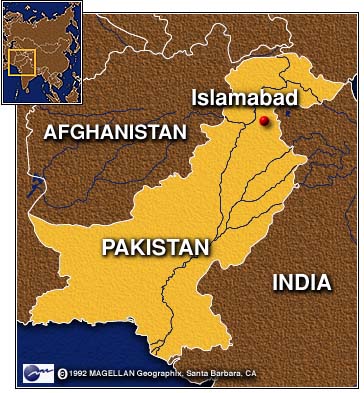
I apologize for the strong-worded title, but I've been asking myself this question since I saw Amy Goodman's interview with Pakistani opposition leader Imran Khan on Democracy Now yesterday. Ostensibly, of course, we're fighting terrorism in Pakistan. More specifically, we're fighting the Taliban, who are supposedly just like the Afghanistani Taliban, if not part of the same entity. We're also fighting the remnants of Al Qaeda. And perhaps we're still looking for Osama Bin Laden? Our method of choice for fighting terrorism has been attacking the bases of suspected militants in the tribal areas of Pakistan with unmanned, remote-controlled aircraft. We're also funding and arming the Pakistani military and pressuring them to eliminate the Taliban from the Swat valley.
The reason I ask what we are doing in Pakistan is because every tactic the U.S. government has chosen is having the exact opposite effect of its officially stated objective. Rather than eliminating the threat of terrorism, each of our actions appear to increase the threat. Imran Khan's interview makes that abundantly clear.
In the latter part of the interview, Amy Goodman asked Imran Khan about his views of the role of the United States in Pakistan and more specifically, the impact of the recent decision to expand the war in Afghanistan and set up a $700 million embassy in Islamabad. In answering the question, Mr. Khan gave a brief overview of the the history of the Pakistani Taliban and argued that the emergence of terrorism in Pakistan is a direct result of U.S. policy in the region, particularly the occupation of Afghanistan:
Well, there was no terrorism in Pakistan, we had no suicide bombing in Pakistan, ’til Pakistan sent its troops on—under pressure from the US. Musharraf, General Musharraf, capitulated under the pressure and sent Pakistani troops into the tribal area and Waziristan. So it was that that resulted in what was the new phenomenon: the Pakistani Taliban. We had no militant Taliban in Pakistan, until we got in—we were forced into this US war on terror by a military dictator, not by the people of Pakistan. And people never owned this war. People always thought that this is not our war, and quite rightly, because we did not have any terrorism in Pakistan, as subsequently grew.I had never heard this explanation before, and was surprised, frankly, to learn that the Pakistani Taliban were such a recent phenomenon. If we are to believe what Mr. Khan says, and I have no reason to doubt him, we must conclude that the terrorists we are supposedly pursuing in Afghanistan would not have existed had we not invaded Afghanistan and/or forced Pakistan to send its army on its own people.
The more operations we did, the more reaction came. And suddenly, as now, we have thirty Taliban groups. I mean, these groups call themselves Taliban, but basically these are radicalized people, these are extremists. And extremism is growing in Pakistan, the more we are being engulfed in this war, which is based in, basically, Afghanistan. So, as long as the US troops are in Afghanistan, I’m afraid there’s no peace in Pakistan either, because the tribal areas are basically—there’s no border there, so the Pashtuns are split between—on the border between Afghanistan and Pakistan, and we have, you know, this movement across the border. And, you know, to send a—think that the Pakistan army is going to stop it—I think Pakistan army itself is going to be stuck in this quagmire, the same as the US in Afghanistan.
Earlier in the interview, Ms. Goodman asked Mr. Khan about the drone attacks in Northwestern Pakistan. He had this to say:
So, so far, I have to say, they—all these operations make no sense. These drone attacks—I don’t know why they haven’t done an analysis that—what are the benefits of drone attacks, and what is the damage done in increased hatred against the US, anti-Americanism?...There’s—according to the Pakistan government, the figures they released, of sixty drone attacks, only fourteen Al-Qaeda were killed, 700 civilians died, not to mention the numbers injured. And so, this collateral damage, each time there’s collateral damage, militancy increases in that area. So this is counterproductive.Unlike the history of the Pakistani Taliban, I was aware of the U.S. drone attacks and the unacceptable level of civilian casualties which they have caused. I discussed the drone attacks in the context of our increasing shift towards robotic warfare in this post last January. His question as to whether anyone has done a cost-benefit analysis of the attacks is a very good one. The impact of the drone attacks, it appears, is quite similar to that of Musharraf's invasion of the tribal areas and our invasion of Afghanistan. Rather than reducing the threat of terrorism, we are radicalizing people and creating fertile ground for the recruitment of more terrorists.
Finally, Mr. Khan dedicated much of the interview to discussing the plight of the people in the Swat valley, which the Pakistani army has recently invaded in order to eliminate the Taliban. The Swat Taliban, of which there are a few thousand, are an even newer phenomenon than the Taliban in the border regions of the country. They are not not well liked by the vast majority of people in Swat, according to Khan. As a result, the people wanted something to be done about them. However, he believes the actions of the Pakistani army in Swat are entirely misguided and are creating a humanitarian disaster:
And it is true that the people wanted some sort of an operation, but not actually what happened. To go after 5,000 Taliban, they have displaced three-and-a-half million people. To use artillery, helicopter gunships, F-16s on civilian population, they’ve caused this massive human catastrophe. And so, yes, people wanted an operation, but they didn’t want this, because this now, if anything, is going to fan militancy. How are they going to rehabilitate these people? Their crops are destroyed. These are subsistence farmers, most of them. Their fruit orchards, their animals. So what are they going to go back to? This is another problem we face now.In other words, the constant theme of U.S. policy in Pakistan repeats itself: rather than solving the problem of terrorism, we have once again chosen tactics which further radicalize the population, not to mention provoking a humanitarian crisis as well. If you'd like to read more about the humanitarian conditions in Swat, in which over 2 million people have been displaced, check out Kathy Kelly's piece in today's Counterpunch. I should warn you, however, that the details are rather horrifying, particularly in light of the fact that the invasion has U.S. backing. Her article ends with a poignant question:
If we want to counter Al-Qaeda, if we want to be safe from further terrorist attacks, we'd do well to remember that even when we don’t recognize the humanity of people bearing the brunt of our wars, these very people have eyes to see and ears to hear. They must be asking themselves, who are the terrorists?In light of the manifest failure of U.S. policy in Pakistan to achieve its objectives, and its high success rate in terms of increasing the threat of terrorism, I return to my original question: Why are we doing what we're doing in Pakistan? During the Bush years, many Democrats blamed the crimes of the administration on incompetence and stupidity. It was a misdiagnosis then, which hid the truly malicious intentions of the Bushies, and I would venture that it's even wronger now under the current administration. Our current president obviously runs circles around our former chief executives intellectually. I doubt lack of competence is a big problem for his cabinet or the military brass either. Unfortunately, I cannot help but reach the conclusion that our current administration knows full well that its behavior in Pakistan is radicalizing the population, increasing the threat of terrorism, killing thousands of civilians, and ruining the lives of millions more innocent people.
My real question then, is what are their motives? The best guess I can come up with is that the U.S. and Pakistani military establishment are truly fearful of the Lawyer's Movement, which lead a successful campaign of nonviolent civil disobedience to restore the chief justice of Pakistan and paved the way for the transition to civilian rule and the end of the Musharraf regime. Perhaps they fear that this movement will lead to the further democratization of Pakistani society, which one day might threaten its status as the best bud of the U.S. and transnational capital. As such, they are destabilizing the country in order to lay the foundations for the return of military rule, which could crush the incipient democracy movement of the Pakistani lawyers. However, the drone attacks began under the Musharraf regime, not when the civilians in power. As such, my logic could be all wrong.
At this point, I remain perplexed. What I do know, however, is that our current strategy isn't working and I'm not naive enough to think that it's just a result of incompetence. Something else is a foot and whatever it is, it can't be good.
domingo, 21 de junio de 2009
If only...
I'll be completely honest, I really have no idea what to make of the post-election turmoil in Iran. Based on what I've seen, mostly on Democracy Now and The Real News, I do not agree with folks like Paul Craig Roberts who claim that the movement is just another CIA-orchestrated/U.S.-backed "color revolution" like the Orange revolution in Ukraine or the Rose revolution in Georgia. Rather, I'm much more inclined to agree with Pepe Escobar of the Real News that the uprising is completely indigenous and a legitimate expression of the will of the Iranian people. I do not claim to be any sort of expert, however. My opinions on the events are exactly that, opinions, laced with a heavy dose of hope.
Regardless of the circumstances behind the uprising, I think Paul Blake, in his interview with Pepe Escobar linked to above, made a very keen observation about the transpirings in Iran. In the last minute of the interview, Blake contrasts the behavior of Mir Hossein Mousavi and his supporters with that of Al Gore and American Democrats in 2000. He points out that Mousavi and his supporters have launched days of protests in cities throughout the country despite facing an authoritarian government and the several thousand member basiji paramilitary force, which has free reign to terrorize the public with impunity. Al Gore, on the other hand, quickly forfeited the election and did not once call for civil disobedience. Seeing the Iranians display such courage, one has to wonder what would have happened if Al Gore had acted like Mousavi and called for demonstrations against the illegitimate election of George Bush. Could anyone seriously deny that thousands, if not millions of Americans would have likely answered his call? And if he had, what would have happened? Perhaps Bush would've won anyway, but he would have had to contend with a large section of the public that not only thought his victory was fraudulent but actively mobilized against him. And maybe, just maybe, Gore would have won. And if he had, he would have had a mobilized, active public to thank for it. A public with high hopes and demands of their president and a public with leverage.
But I digress. Here's to hoping that folks like Paul Craig Roberts are wrong and the people of Iran continue displaying such awe inspiring courage. Most importantly, I hope their efforts are not in vane and they are able to construct a more just, open, and democratic society for themselves as a result of these protests.
Regardless of the circumstances behind the uprising, I think Paul Blake, in his interview with Pepe Escobar linked to above, made a very keen observation about the transpirings in Iran. In the last minute of the interview, Blake contrasts the behavior of Mir Hossein Mousavi and his supporters with that of Al Gore and American Democrats in 2000. He points out that Mousavi and his supporters have launched days of protests in cities throughout the country despite facing an authoritarian government and the several thousand member basiji paramilitary force, which has free reign to terrorize the public with impunity. Al Gore, on the other hand, quickly forfeited the election and did not once call for civil disobedience. Seeing the Iranians display such courage, one has to wonder what would have happened if Al Gore had acted like Mousavi and called for demonstrations against the illegitimate election of George Bush. Could anyone seriously deny that thousands, if not millions of Americans would have likely answered his call? And if he had, what would have happened? Perhaps Bush would've won anyway, but he would have had to contend with a large section of the public that not only thought his victory was fraudulent but actively mobilized against him. And maybe, just maybe, Gore would have won. And if he had, he would have had a mobilized, active public to thank for it. A public with high hopes and demands of their president and a public with leverage.
But I digress. Here's to hoping that folks like Paul Craig Roberts are wrong and the people of Iran continue displaying such awe inspiring courage. Most importantly, I hope their efforts are not in vane and they are able to construct a more just, open, and democratic society for themselves as a result of these protests.
miércoles, 17 de junio de 2009
By narrow margin, congress passes war appropriations bill. Dennis Kucinich responds
Yesterday, by a narrow margin, Congress passed a war appropriations bill, totaling over $100 billion dollars. The bill will fund the continued occupation of Iraq, an expansion of the war in Afghanistan, and provide the International Monetary Fund (IMF) with billions in additional capital, apparently to wage economic war against the third world. Congressman Dennis Kucinich (D-OH) responded to the passage of the bill:
There’s money, too, for the IMF, presumably to bail out European banks, billions for the IMF, so they can force low- and middle-income nations to cut jobs, wages, healthcare and retirement security, just like corporate America does to our constituents. And there’s money to incentivize the purchase of more cars, but not necessarily from the US, because a Buy America mandate was not allowed. Another $106 billion, and all we get is a lousy war. Pretty soon that’s going to be about the only thing made in America: war.
Suscribirse a:
Entradas (Atom)


